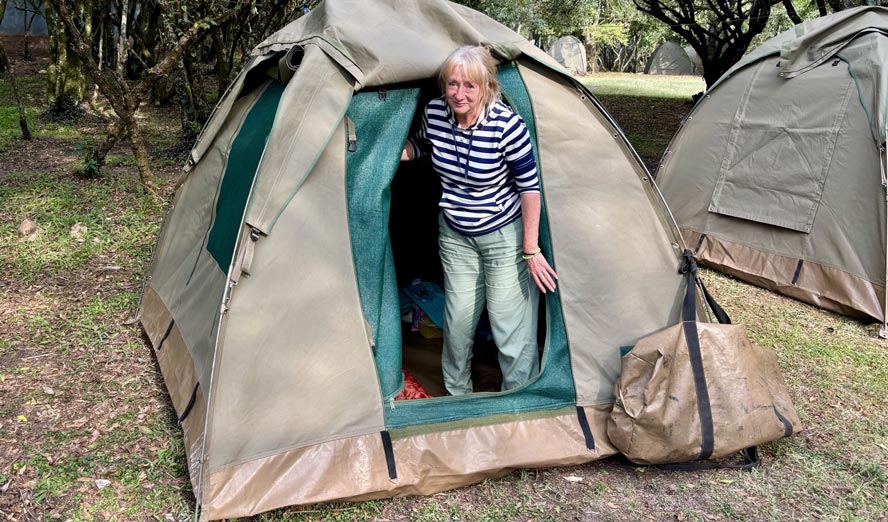
Jumbo! again,
For years I’ve had Maasai Mara on my list. Though only 5% the size of Serengeti it has a higher concentration of wildlife. The River Mara divides Maasai Mara and Serengeti. It forms part of the border between Kenya and Tanzania. The Swahili word mara means park.
Each year a million animals, mainly wildebeest, cross the river. They follow the rains in search of green pastures. The migration of the wildebeest is considered one of the seven wonders of the natural world. Though late in the season, we still hoped to experience this phenomenon.
We scanned the horizon. There were dazzles of zebras and harems of impala. All heads turned as a hyena sauntered past, but food wasn’t on his mind. It was on ours. At lunch we sat on the riverbank next to a trail of fresh footprints. A hippopotamus had recently walked past.
A bloat of hippos was semi-submerged in the river below, keeping company with an extremely large crocodile. A band of fun-loving vervet monkeys swung by. Vervet monkeys love a picnic. After lunch excitement rose as we came across two lions hidden in a bush; shortly after we encountered a pride. As for the million or so wildebeest, we spotted just two. I personally want to thank those two wildebeest for staying behind just for us!
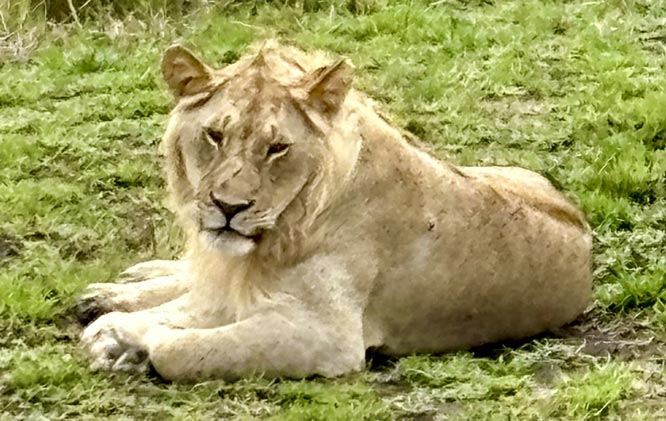 By now most of us had a favourite animal; for some it was the sinuous leopard, others the majestic lion. For our guide it was the warthog, the trickster.
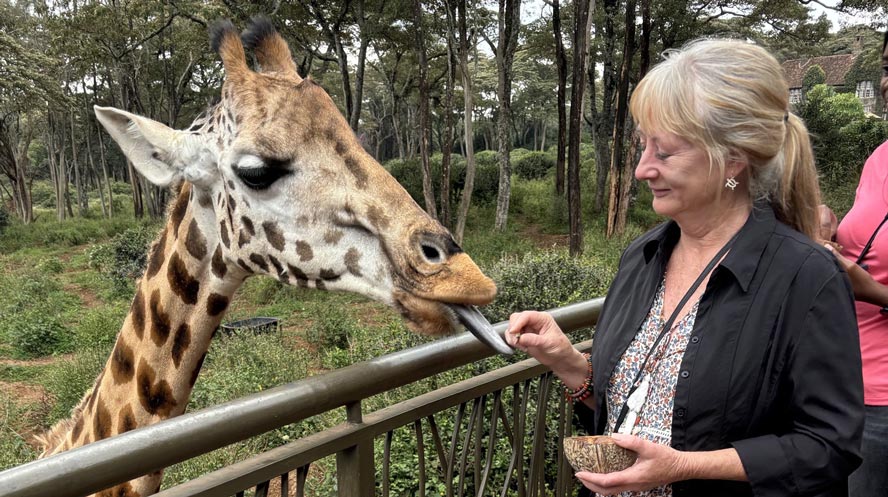
Warthogs never failed to amuse. For me it was the giraffe; slow-moving and gentle. At the Giraffe Centre I learnt all things giraffe.
There are four different species of giraffe, each from a different region of Africa.
The different species aren’t able to successfully inter-breed. Like humans, giraffes have only seven vertebrae in their necks; very large vertebrae.
They also have very long tongues, 50cm in length. What a wondrous feeling it was having a giraffe’s long purple tongue wrapped around your fingers as you fed her. Yet another memorable moment!
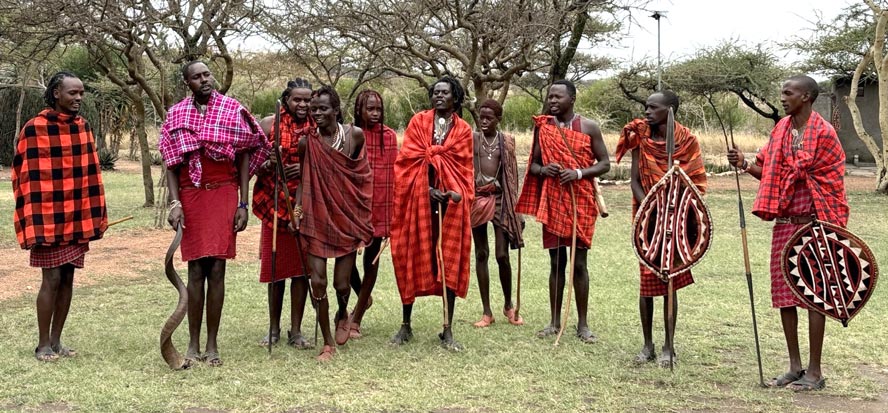
The leopards are not a favourite of the Maasai. Despite the tall fences the Maasai had constructed to protect their stock, the leopards would still jump the fence, indiscriminately killing after a dozen or more goats. The Maasai welcomed us to their village; singing, dancing and describing aspects of their lives. Being vegetarian isn’t an option for Maasai.
As we tucked into our lunch of salad and tropical fruits, the Maasai stuck with their cow’s blood milkshakes and mixed grilles. There are about one million Maasai in Kenya. They have many children; numbers are increasing.
The culture is for young girls to marry older men. Men can have up to ten wives. In 2014 polygamy was declared legal in Kenya. The Maasai also practise FGM, however education programmes are underway to curb this.
It’s Sunday in Kenya and it shows. The villages are filled with well-dressed folk on their way to church. The women are resplendent in their colourful clothing, the men look dapper in their suits. There are 745 million Christians in Africa, about half of Africa’s population. Some of the churches are tin-sheds, some are mud-brick, others are grand structures, sometimes still under construction.
In the villages many buses have religious messages on them; Blessed, God is Great, Blessed are the Meek. The latter message wouldn’t work in Nairobi. The traffic jams are legendary; however people are patient.
While stuck in traffic many hawkers pass by selling sunglasses, tennis rackets, a six-pack of soccer balls, a cruet set, water bottles, CDs, artworks, Nice biscuits, potted asparagus ferns. You could do your entire Christmas shopping while stuck in traffic. Being a policeman on point duty is not a job for the faint-hearted.
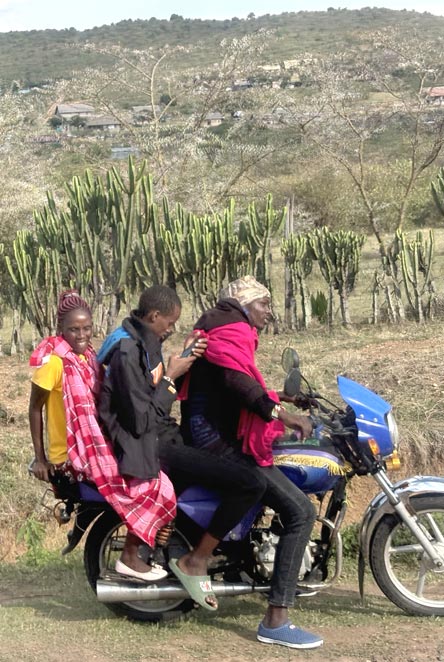
Our last few days in Kenya, we travelled along bumpy roads, more opportunities to experience African massages, enjoy quirky signage and view the usual array of commercial activity lining the roads; metalwork manufacturers, furniture manufacturers, coffin manufacturers.
The orange tulip trees were beginning to bloom, women were scrubbing clothes, and as usual men were sitting about on old tyres.
Returning to Nairobi I felt more affection for this large, dusty city. I sought out Vincent, a Rwandan refugee, who has a pavement bookshop. The bookshop combines his passion for reading as well as a chance for the odd conversation on books.
I emerged with books by Kenyan, Ugandan and Nigerian writers. Nairobi has only been the capital since independence in 1963. Prior to that the capital was in the ancient Swahili city of Mombassa.
I would have loved to visit Mombassa, but that’s a destination for another visit. For now it’s kwaheri, bye-bye, Nairobi.
Still travelling,
Ros